
Oh, It's Just Batman
Ralph DiBernardo’s long run from fandom to civic backbone: how a Portsmouth kid turned shopkeeper found purpose in helping rebuild a mill town.

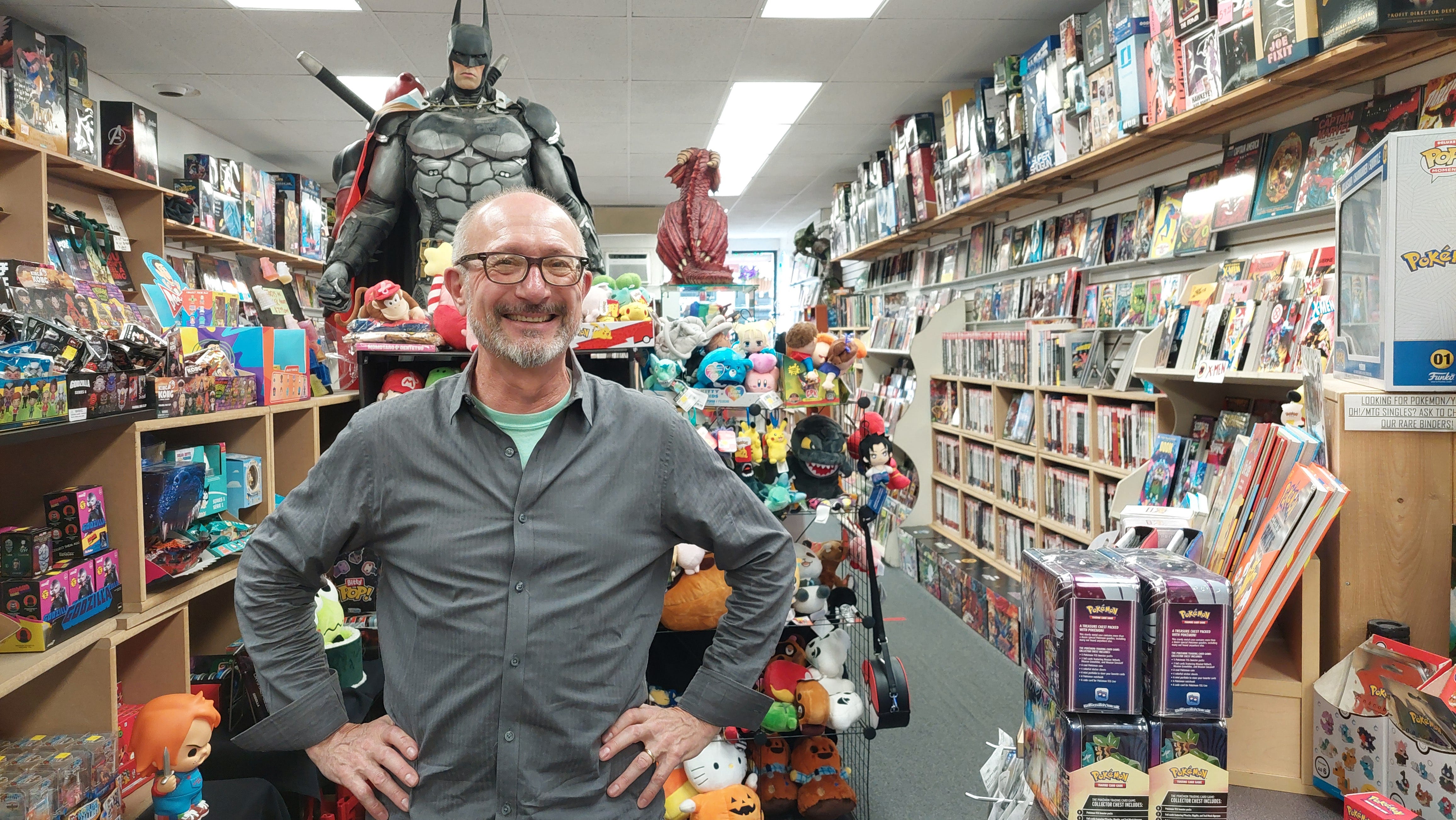
Huge walls of bagged comics, new issues, back issues, and collector editions all spilling into long boxes on the floor, racks of graphic novels, display cases with Batman lunging on a wire, Obi-Wan caught in flame, Groot towering from above, Boba Fett watching from the window, Gundam model kits stacked like fortresses against shelves of Funko Pops and dice and paints and binders, every aisle dense with inventory, vintage covers shouting from the past while brand-new titles scream THIS WEEK, all messy and overwhelming, part museum, part treasure hunt, part community hub, absolutely alive with Teenage Mutant Ninja Turtles frozen mid-battle, all built by people who love comics so much they want you to feel immersed the very moment you step into this unruly cathedral of geek culture—this is Jetpack Comics. Twenty years strong. Still bursting at the seams.
“The turtle guys are friends,” shrugs Jetpack owner Ralph DiBernardo.
On Hanover Street, before urban renewal swept through Portsmouth, Weinbaum’s Magazine Shop sat inside the brick bones of the Joshua Wentworth House. By the 1960s, the building had become a newsstand. Candy at the counter, headlines on the racks—the Boston Globe and New York Times stacked in neat bundles. Front pages fanned like invitations. From that Hanover Street address, the Weinbaum family supplied periodicals to newsstands across the Seacoast. Ralph was probably the only kid who had memorized the timing of deliveries down to the hour for that week’s selection of comic books.
“I fell in love with the Fantastic Four. You know, it was husband, wife, brother, best friend. I just really enjoyed the storytelling that went along with that because they were as much a superhero team as they were a family,” said Ralph.
He had amassed a Fantastic Four collection beginning with Issue 11 and onward. The search for the previous ten books began by pedaling the length of Portsmouth. The bicycle tires hissing on damp brick, salt air in his teeth. Past Green’s Drug Store. Past the bus stop. From antique shop to antique shop. Those first ten issues became a quest more than completing a collection. The first score came from a dusty long box near a stack of westerns—Fantastic Four #9, scuffed but complete, enough for a grin that lasted all week.
Wicked Moxi
Equal parts grassroots journalism, civic action, and cultural chronicle. Studs Terkel with caffeine and attitude.

☕A Coffee with Steve publication.

Then, by the time Ralph was in the sixth grade, his old typewriter started click-clacking articles together for publications like Maine Antique Digest. He walked away with $500 per weekend at the big indoor flea market in the old Mars Bargainland in Newington, now today’s Walmart. He’d started in the back with one table and a folding chair; by year’s end, he’d inched forward to the entrance underneath the fluorescent. Ralph’s long boxes ran in ranks, hand-lettered dividers, price tags penciled in. The flip-flip cadence of cardboard sleeves across three tables. He learned faces, pulled holds, timed his stock for the rush.
By the next summer, he had a distributor and wholesale boxes.
Two of Ralph’s regulars radiated nerd-joy every Sunday. The one, Kevin, with mop hair and mustache, the other, Peter, almost the exact opposite, round head and round glasses, but both full of kinetic grin energy.
In the limited 3000 copy run of the April 2005 reprint of the Teenage Mutant Ninja Turtles, Ralph wrote in the forward that he didn’t even realize Kevin Eastman and Peter Laird even had any interest in being artists, let alone aiming to go pro. Ralph just figured they were “two guys who loved to buy good comics with taste.”
The three boys’ Sunday conversations often drifted into shop talk centered around the now defunct Star*Reach magazine—an early forerunner of the 1980s indie/direct-market boom where names like Howard Caykin, Jim Starlin, Barry Windswor-Smith, P. Craig Russell. Roger Zelanzny. All heavy weights before they were actually big.
That Star*Reach chat, creator-owned dreams, oddball anthology experiments, roadmaps for doing comics without permission, that shared taste nudged their conversations toward self-publishing and consignment hustle; it was that bridge, that underground attitude coupled with mainstream polished craft, exactly the lane that made a home-printed ninja turtle comic feel inevitable.
So one weekend, Kevin and Peter placed a new black-and-white across Ralph’s table. Ralph wasn’t sure if the comic was going to be a hit, but Ralph bought 500 copies of TMNT #1, paying 60–90 cents each.
“Just to help them pay back their uncle,” Ralph said.
Ralph placed copies on consignment all over the Seacoast. There was a time in New Hampshire when you couldn’t escape the Teenage Mutant Ninja Turtles.
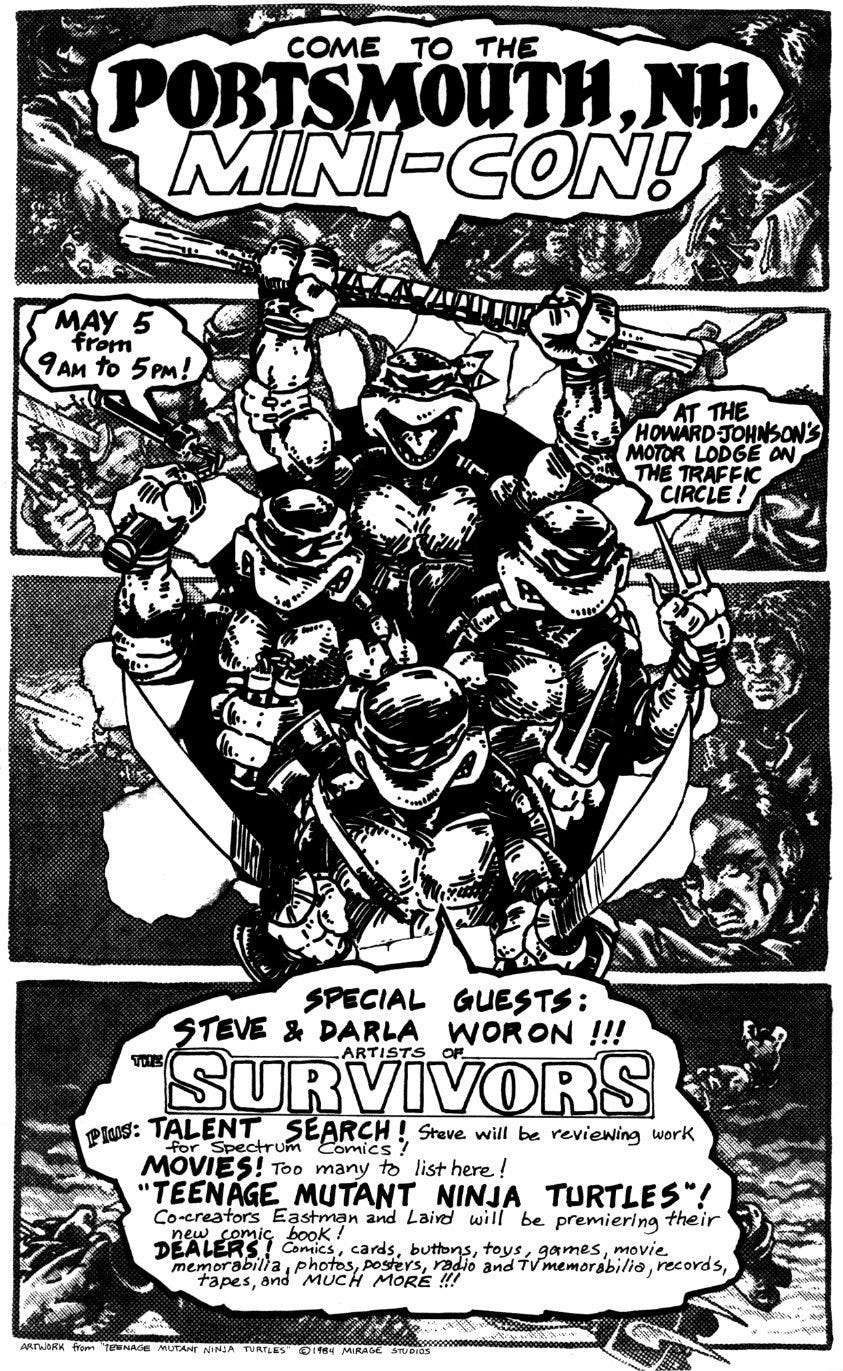
In 1983, Ralph opened an official comic book store downtown Portsmouth adjacent riding the tail end of Cold War military prosperity in the Seacoast. He had just graduated high school. And a year later, 1984, he launched the first Portsmouth Mini-Con, featuring, of course, the Teenage Mutant Ninja Turtles debut.
The Seacoast’s military infrastructure was operating at near-full tilt. The Atlantic wind scouring off Great Bay while FB-111A bombers, their swing-wings folded forward for takeoff, streaked upward two at a time. Below them, KC-135 Stratotankers. From Dover to Kittery, you could look up and see that choreography: the fat-bellied tankers lumbering over the bay, the dark arrowheads of the bombers sweeping in to drink.
The Pease Air Force Base-related population sat at near 10,000. And for the first time in decades, the Portsmouth Naval Shipyard didn’t expand—less overtime, fewer apprentices hired. The Navy termed it workload-realignment.
The Eastman and Laird took out and paid for a full ad, and Ralph yelled at them several times to stop taping stuff up to the walls at the Howard Johnson while he cut up actual copies of the TMNT comics for postcards and flyers. 200 people attended that first con.
“Military guys are famous for devouring comic books,” grinned Ralph.
Then the second Comic-Con about a year later, in the Days Inn basement, only about fifty showed.
The “Castle,” the Portsmouth Naval Prison, had already been empty since 1974, but in 1985, the Navy mothballed the Gothic monument that had stood since 1908. The Navy simply walked away. Steam lines were drained, windows boarded, doors missing, the roof collapsing.
What followed that year, in 1985, was a wave of Reductions in Force, the government’s bureaucratic term for layoffs and hiring freezes. This was the first serious contraction of the local defense economy. Then, in 1988, Pease Air Force Base became one of the first casualties of the Base Realignment and Closure process meant to pare down the Cold War defense footprint.
“Within six months, most of my customer base was gone,” said Ralph. “This was long before Portsmouth became the iconic Portsmouth that it is now. Back then, it was a sketchy place. Seedy characters.”
By 1991, active duty operations ended.
“So when the two bases kind of left—they didn’t really leave, but they definitely got rid of a ton of people. I decided to get out,” said Ralph.
Ralph sold his Portsmouth shop and started traveling the Star Trek convention circuit. Early morning load-ins at some fluorescent-lit convention hall in Tacoma, Philadelphia, Las Vegas, Minneapolis, just Ferengi-style selling junk merchandise to Trekker Federation loyalists.
“It was just constant. Every weekend in a different state. I just got sick of that lifestyle.”
When he returned to his Seacoast home, Ralph became the kitchen manager at Weeks Restaurant in Dover until the owner, David Weeks, sold the property to Chili’s Grill & Bar. He went down the road to another restaurant in the current Tri Market Place, where he discovered Paperback Bazaar.
“They were right there where the Market Basket is in Somersworth.”
“I saw stuff on the wall I’d never seen before.”
Marvel was in bankruptcy, and DC was experimenting.
Brian Michael Bendis and Mark Bagley dropped the Ultimate Spider-Man, which rebooted Peter Parker from scratch. The book slowed everything down, and Peter’s teenage awkwardness became cinematic realism; the “with great power” myth reborn for a post-Clinton youth, and made Marvel human again. Grant Morrison’s The Invisibles: sex magic, time travel, drugs, chaos theory, pop culture as ritual. The universe as prison, art as the jailbreak. Warren Ellis and Darick Robertson’s Gonzo journalist Spider Jerusalem in Transmetropolitan predicted Twitter, fake news, and the weaponization of outrage. Every issue dripped with fury and moral exhaustion. Garth Ennis and Steve Dillon’s blasphemous Preacher, possessed by a half-angel, half-demon, hunting down a God who abandoned Heaven.
But what stayed was the myth of the hero. The idea that no matter how strange the powers got or how far the world fell apart, somebody still stood up, still fought for the people they loved.
Peter Parker fumbled forward toward Aunt May, Mary Jane, Gwen. Every battle really about keeping that fragile web from breaking. King Mob, the gun-toting anarchist with too many ghosts; Boy, the ex-cop seeking redemption; Ragged Robin, the unraveling time traveler; Lord Fanny, the trans witch who turned trauma into spellwork; and Jack Frost, the street kid messiah who had to learn that saving the world means loving it. They bicker, fracture, disappear into time, come back. They dance on the edge of apocalypse and call it a family. Channon Yarrow and Yelena Rossini start as interns, but become Jerusalem’s people. They fight him, save him, walk out on him, come back, hold him up when he’s literally disintegrating from illness and burnout. He can’t admit it, but they’re the only family he’s got. Jesse, Tulip, and Cassidy kerouaced across a desecrated America looking for God and finding only each other.
Seeing that wall of story, Ralph fell right back into buying comics again. Eventually, he became the Paperback Bazaar manager. When the rent went from two grand a month to four grand a month, Paperback Bazaar literally priced out of existence, Ralph asked for the store’s mailing list. He met customers in parking lots, drug deal style, pushing books directly from the trunk of his car.
“I was always waiting for a cop to come up and be like, what the hell are you doing here? What are you selling? And be like, oh, it’s just Batman.”
He shortly opened JetPack Comics on Portland Street in Rochester.
Like other mill towns, Rochester’s core had suffered disinvestment in infrastructure and buildings, depressed values, and lost vital foot traffic through the early 2000s. The City Hall Annex had been gutted and left to rust for nearly a decade. From the rails of the mills to the vacant blocks, police cruisers became familiar at dusk in the alleys behind the few remaining shops. Blue tarps pitched against the loading docks of old textile buildings, sagging awnings, faded murals, windows busted by vandals, potholes that swallowed hubcaps, and sun-bleached For Lease placards.
In 2006, Rochester formally adopted the National Main Street framework to reverse that post-industrial ghost Ralph had stepped into. One late night, working to set up at his new location on North Main Street, he looked out the window and wondered what he had gotten himself into.
The street half-lit and uneven. Twenty motorbikes parked diagonally on the street. The riders in jeans stiff with grease stumbled out of the bars. Drunk. Smoking cigarettes and other things. They kicked on their motors, that syncopated rough growl deepening into a steady thrum-thrum you felt in your ribs. The air smelled like exhaust and hot metal. And right down the line: one two three… a half-naked woman hanging onto the back of each bike.
That first year on Portland Street, Ralph hosted Free Comic Book Day. A few hundred people showed up—some local, some from the industry, a handful of artists and writers he knew from his years in comics—about the same kind of crowd that showed up at the Portsmouth Mini-Con way back in 1983.
In the second year on Portland Street, he threw up a circus tent beside the store, added vendors, and created a small convention. That’s when he first heard about Rochester Main Street, the local arm of a national program dedicated to revitalizing downtowns through community-led development.
“I came into it with the attitude of, ‘What can you do for me?’” he admits. “And I was kind of mouthy and vocal.” He laughs at himself now. “I hadn’t grasped my civic duty yet, my responsibility to my community.”
When the crowd doubled in that second year, he began connecting with nearby businesses, the lesson hit him: you don’t just take from the town—you build with it.
“I started realizing, if I didn’t like something, it was my responsibility to help make it better.”
By the third year, he’d partnered with Rochester Main Street to expand the event into a full downtown takeover—fifty-plus tables of local creators, nonprofits, and national guests.
“We’ll give out five-dollar gift cards to libraries for reading prizes,” he says, almost embarrassed. “Last year alone, we gave away just shy of a hundred thousand dollars’ worth of merchandise to schools and nonprofits.” His small-business peers call him a bit crazy for giving away that much in gratitude, but that’s also why his peers also like him.
When Ralph invited Eastman to the Free Comic Book event, attendance exploded—from a few hundred to thirty-five hundred. The next year, Eastman reached out to Laird.
“They hadn’t spoken in twenty years,” Ralph said. “And that year, we had seventy-five hundred people come through. It was a madhouse.”
Between the fall of 2016 and August 2017, Rochester restored the City Hall Annex facade, replaced the roof, rebuilt the cupola, and finished the interior. The once-abandoned shell is home to Rochester’s Planning and Economic Development departments. The city’s Downtown Plan describes pocket parks, planting strips, streetscape, and parking-lot upgrades as part of revitalization. Building owners who make significant improvements to downtown buildings can tap into a property-tax incentive. The Contributing Partner Program invites residents and local businesses to invest directly in downtown’s future, turning civic pride into currency. Beneath the murals and music, there’s infrastructure: grant writing, merchant coordination, late-night meetings, the quiet hum of spreadsheets and stubborn optimism. The transition from biker-night chaos to curated streetscape has become visible.
Today, Ralph sits on the board for Rochester Main Street and serves on the city’s parking commission. “Even to this day,” he says, “I just want to do my part. This community has done nothing but give to me, and I just want to give back everything I can.”
Because it was never just about Batman.
It's the pulse of a small town rediscovering itself through passion and persistence because it’s not just about comics, but about the kind of stubborn hope that can build a community, one story and one neighbor at a time, right?